

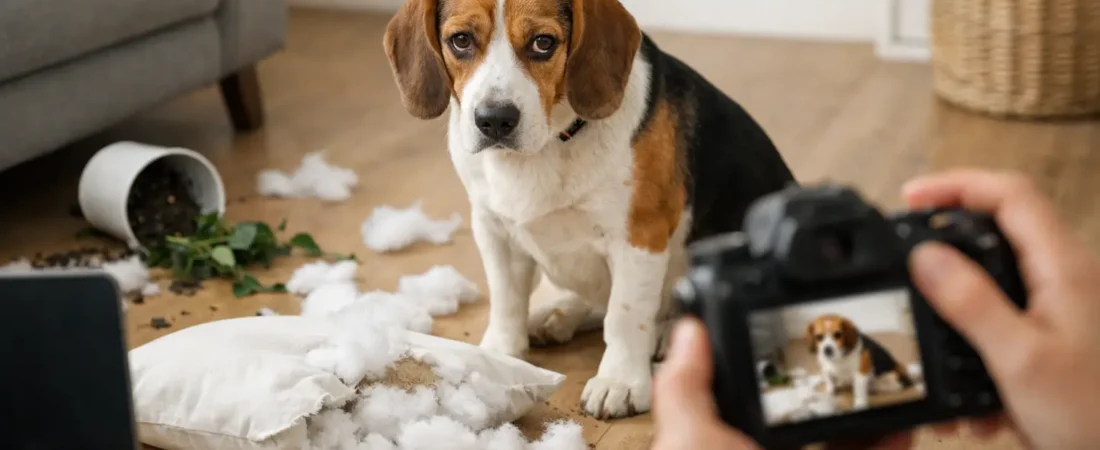
The photo already has the evidence. Your dog is standing next to the shredded pillow, side-eyeing the room like legal counsel has advised silence, and somehow you still need the right words. If you’re figuring out how to caption guilty dog photos, the trick is not just being funny. It’s matching the caption to the exact kind of canine crime, the face in the frame, and the level of drama your defendant is bringing to court.
A weak caption states the obvious. A good one adds a point of view. The best one makes people feel like they walked in halfway through a very serious hearing involving one torn couch cushion and a suspiciously smug French Bulldog.
How to caption guilty dog photos without forcing it
Most guilty dog photos fail in the caption department for one simple reason. The owner tries too hard to sound like a meme instead of reacting to what is actually happening in the image.
Start with the photo itself. Is your dog looking ashamed, confused, falsely accused, or completely unbothered? Those are four different jokes. A muddy Australian Shepherd staring at the floor gives you one lane. A Husky yelling at you from inside the laundry basket gives you another. If the expression says innocence, don’t caption it like a confession. If the expression says, “I regret nothing,” lean into that.
The strongest captions usually do one of three things. They issue a fake legal statement, they let the dog speak in first person, or they describe the crime scene like a dramatic case file. All three work because they create tension between the seriousness of the wording and the ridiculousness of the behavior.
For example, a Boxer standing over a demolished package might be funnier with, “I intercepted a suspicious delivery.” A Dachshund halfway under the couch after stealing a sock works better with, “I can explain the tunnel, not the sock.” Same category of mischief, different comedic angle.
Pick the joke structure before you write
If you want your caption to sound sharp instead of random, choose a format first. Think of it as selecting the court procedure before the trial begins.
The mock confession works well when your dog’s face looks undeniably caught. This is the classic “I did it and I’d do it again” energy. A Boston Terrier with whipped cream on its nose can carry a caption like, “I maintain that the pie was unsecured.”
The formal accusation works when the photo includes physical evidence. Torn paper, muddy paws, overturned trash cans, and missing sandwich bags all help. In those cases, a caption framed like a charge sheet lands fast: “Charged with destruction of one paper towel roll and obstruction of cleanup.”
The fake defense statement is best when your dog looks misunderstood. A mixed-breed rescue sitting sweetly beside a toppled plant practically begs for, “My client was merely near the soil.” This structure gets laughs because every dog owner has seen that look – innocent in theory, incriminating in context.
Then there is the deadpan understatement. This is often the funniest option when the mess is huge. A Great Dane next to a collapsed holiday display doesn’t need a paragraph. “There was a minor incident” is enough.
Match the caption to the dog’s expression
This matters more than people think. The face is doing half the writing.
A head tilt reads as confusion, not guilt. A lowered gaze can read as guilt, but it can also read as “please stop talking and feed me.” Wide eyes often suggest surprise or theatrical innocence. A grin on a guilty-looking dog is comedy gold because it shifts the tone from shame to repeat offender.
That’s why specific phrasing beats generic lines. “Who, me?” works once, maybe twice. After that, it starts sounding like every other caption on the internet. Instead, write for the expression in front of you. If your Shih Tzu looks deeply offended by the accusation, give the dog dignity. If your Cattle Dog looks like a tiny criminal mastermind, make the caption sound calculated.
A useful test is to cover the rest of the photo and look only at the face. What emotion hits first? Write from that. Then bring the evidence back in.
Use the crime scene, not just the dog
People laugh hardest when they can reconstruct what happened in two seconds.
The overturned hamper, the chewed remote, the flour trail across the kitchen, the single bite taken from the center of a loaf of bread – those details do the heavy lifting. Your caption should point to the funniest piece of evidence, not narrate every item in the room.
If a Miniature Schnauzer is surrounded by stuffing, mention the victim. “The squeaky duck will not be testifying.” If a Lab mix has stolen half a birthday cake, focus on motive. “I acted in the interest of frosting security.” When the visual is chaotic, one sharp detail beats a full explanation.
This is also where timing helps. If you’re posting right after the event, your caption can sound like a live court filing. If the photo is older, a retrospective tone can work better: “Case reopened after new crumbs surfaced.”
How to caption guilty dog photos for social media shares
If your real goal is comments, shares, and texts sent to other dog owners, write captions people can instantly retell. That usually means shorter, cleaner, and more specific.
A long caption can work on Instagram if the photo is excellent and the joke builds well. On faster platforms, the best line is often under 12 words. Not because short is always better, but because punchlines need room to breathe.
Instead of writing three jokes in one caption, pick the best one. A photo of a Bichon Frise wrapped in toilet paper doesn’t need setup, backstory, and a closing argument. “The bathroom search warrant got out of hand” is enough. Let the image carry the rest.
It also helps to avoid overused internet phrasing unless you can twist it. “No regrets” is tired. “No comment until my groomer arrives” feels fresher. Familiar structure, better detail.
If you know your audience includes fellow dog owners, you can lean into shared household crimes. Sock theft, counter surfing, unauthorized digging, and package inspection are universal. The more recognizable the offense, the easier the share.
Breed quirks can make the joke better
Used lightly, breed-specific behavior adds realism and charm.
A Husky caption can get a little argumentative because everyone expects a rebuttal. A Border Collie caption can hint at suspicious efficiency. A Dachshund can absolutely be portrayed as operating a tunnel-based defense strategy. A Boxer often works best with full-confidence nonsense. A senior mixed breed who stole a chicken nugget deserves a caption with veteran energy, not chaos.
The key is to use quirks as seasoning, not the whole meal. You want the caption to fit the individual dog in the photo, not sound like a generic breed meme. If your Poodle looks elegant even while guilty, write for that. If your rescue mutt has the posture of a suburban raccoon, honor the truth.
A few caption habits that quietly ruin the joke
Too much explanation is the biggest one. If you have to explain why the caption is funny, the jury has already left.
The second mistake is using baby talk when the image wants mock seriousness. Some photos are funniest when written like an official report. Others want a first-person dog voice. Mixing both in one line can muddy the joke.
Third, don’t fight the photo. If your dog looks proud, don’t write shame. If the mess is tiny, don’t oversell it like a national emergency. Humor works when the charge fits the crime.
And yes, punctuation matters. A guilty dog caption usually lands best with clean, simple rhythm. One line. Maybe two. Enough space for the stare to do its job.
Easy formulas when your brain goes blank
When inspiration fails, use a repeatable structure and swap in the evidence.
Try “Charged with…” for clear crime scenes. Try “My client insists…” for photos with plausible deniability. Try “I was told there would be no witnesses” for caught-in-the-act faces. Try “For the record…” when your dog looks defensive. Even a simple “This is not what it looks like” can work if the photo is outrageous enough.
If you want a slightly more branded style, a courtroom angle gives you a lot to work with without making the caption feel forced. Verdicts, testimony, exhibits, appeals, and mistrials all fit naturally with pet chaos. Judge Fable would likely agree that a corgi seated beside a stolen roast chicken deserves at least a hearing.
Still, the best formula is the one that sounds like something you would actually post. If your humor is dry, keep it dry. If you like dramatic captions, get dramatic. A good caption feels natural to the owner and perfectly unfair to the dog.
The real secret is simple. Don’t caption the dog. Caption the case against them, the defense they wish they had, or the absurd confidence with which they committed the act. When the words fit the face and the evidence speaks for itself, the verdict usually writes itself.