


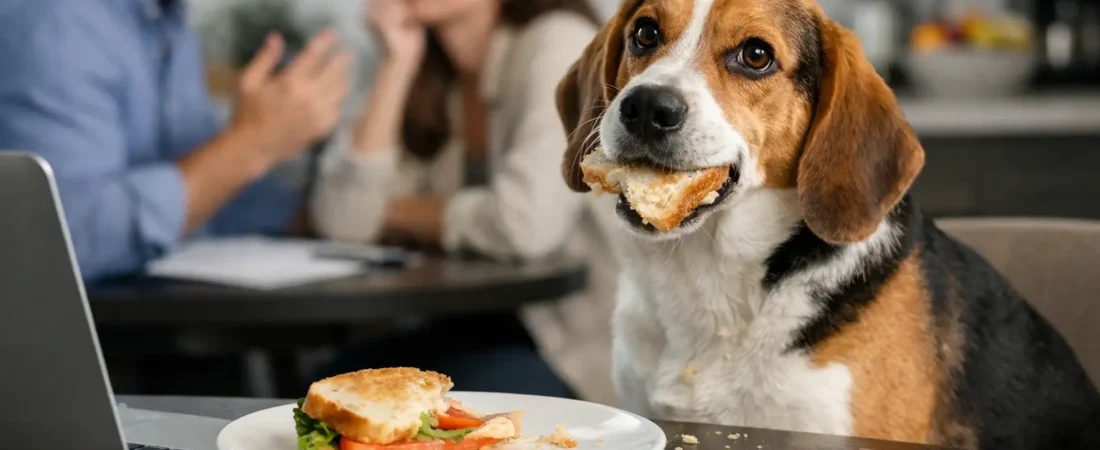
You turned away for six seconds, and now your turkey on sourdough has vanished like it entered witness protection. If your first thought was, dog stole my sandwich, the court would like to note that you are not alone, and your defendant is not sorry. Most dogs are opportunists with fur. A sandwich left unattended is less a meal and more an open invitation.
Still, there is good news for the prosecution. Food theft is common, but it is also very workable. You do not need a perfect dog, and you do not need to eat standing over the sink forever. You do need to understand why it happens, how your dog is being rewarded for it, and which household habits quietly turn snack stealing into a recurring offense.
Why the dog stole my sandwich in the first place
Dogs do not steal sandwiches because they are plotting against you personally, though the timing can feel vindictive. They steal food because it works. Human food smells stronger, tastes richer, and often sits at nose level for just long enough to be stolen. One successful grab can create a powerful lesson – when food appears, move fast.
Breed tendencies can play a role. Sporting breeds, scent hounds, retrievers, and many mixed-breed dogs are especially motivated by food and quick to investigate countertops, coffee tables, backpacks, and strollers. Age matters too. Puppies are impulsive, adolescents are ambitious, and many adult dogs simply have a long and distinguished record of getting away with it.
Environment matters as much as training. If your dog has regular access to unattended meals, dropped crumbs, or children carrying half-eaten toast through the living room, the case keeps reinforcing itself. Dogs repeat behaviors that pay well. Sandwich theft pays extremely well.
First ruling – make sure the sandwich was safe to steal
Not every stolen sandwich is just annoying. Some ingredients can make lunch theft a genuine medical issue. If the sandwich contained onions, garlic-heavy spreads, grapes, raisins, chocolate, xylitol, lots of macadamia nuts, or a large amount of fatty meat, call your veterinarian right away. The same goes for cooked bones, corn cobs, skewers, wrappers, or sandwich packaging that may have been swallowed.
Even when the ingredients are dog-safe, quantity matters. A tiny dog who inhaled half a deli sandwich may end up with vomiting, diarrhea, or a miserable evening. A larger dog might seem fine and then develop stomach upset later. If your dog is acting distressed, trying to vomit, bloating, or unusually lethargic, do not wait it out.
This is the part where comedy yields to procedure. The court enjoys a good food-heist narrative, but not at the expense of your dog’s health.
Why punishment usually fails
When owners catch a dog licking mayo off the rug, the instinct is to scold. Fair. Human. Usually ineffective.
By the time you react, the reward is already in your dog’s stomach. From your dog’s point of view, the sequence is simple – steal sandwich, enjoy sandwich, maybe hear loud human noises afterward. That does very little to reduce the behavior and can make some dogs sneakier or more anxious around food.
A better approach is prevention plus practice. Prevent the theft whenever possible, then teach your dog what to do instead when food is present. That is how you stop the repeat offense, not just complain about Exhibit A.
How to stop sandwich theft at home
Management comes first because it works immediately. If you keep food out of reach, your dog cannot rehearse stealing it. That means clearing coffee tables, pushing plates back from edges, using baby gates during meals, closing lunchboxes, and treating low counters as fair game in your dog’s mind, because to them they absolutely are.
If your dog cruises the kitchen during meal prep, create a default parking spot. A dog bed, mat, or place cot works well. The goal is not to exile your dog from family life. It is to give them a consistent job that pays better than theft. You can reward your dog on the mat with kibble, a chew, or tiny treats while you make lunch. Over time, the mat becomes the profitable choice.
Teach a strong “place” cue
A reliable place cue is one of the best tools for food thieves. Start when no sandwich is involved. Guide your dog onto the mat, mark the behavior with a cheerful yes, then reward. Repeat until your dog begins choosing the mat quickly. Add duration in small steps. A few seconds becomes ten, then thirty, then a minute.
Once your dog understands the job, practice with mild distractions first, then real-life ones. Sit down with a snack while your dog stays on the mat. If they get up, calmly guide them back and lower the difficulty. If they stay put, pay them well. You are building a case history of success.
Use trades, not wrestling matches
If your dog already grabbed the sandwich, avoid chasing or prying unless there is an urgent medical danger. Pursuit can turn theft into a thrilling game, and grabbing at your dog may increase guarding behavior in some dogs.
Instead, use a trade. Offer a higher-value treat, call your dog away in a happy voice, and exchange fairly if it is safe to do so. Then manage the environment better next time. You are not bribing criminal behavior. You are preventing a secondary charge called resource guarding.
Practice leave it before you need it
Leave it is not magic, but it is useful. Teach it away from mealtime with a boring item in your hand first. Reward your dog for backing off and checking in with you. Then gradually increase the challenge with food on a table, food in your lap, and eventually a realistic lunch setting.
The catch is that leave it is hardest when a dog has a long history of self-rewarding theft. So yes, train it. Also keep the sandwich out of range while the skill is still under appeal.
The hidden habits that keep the crime spree going
Sometimes owners do train, but the household keeps undermining the verdict. One family member feeds scraps from the couch. Another leaves breakfast plates on the ottoman. Kids wander off and set snacks at dog height. The dog learns that rules are less laws and more suggestions.
Consistency matters more than intensity. You do not need everyone to become a drill sergeant. You do need shared standards. Meals happen at tables or counters. Food is not left unattended. Guests are told not to feed the dog from their plate. If your dog is especially determined, use gates or a crate with a chew during meals until the new routine sticks.
Counter surfing deserves special mention. If your dog steals sandwiches from counters, not just laps and coffee tables, this may require more management than training at first. Clear counters completely, store food farther back than you think necessary, and prevent access when you cannot supervise. A dog who finds one forgotten ham sandwich after two clean weeks has just been paid enough to reopen the case.
What if your dog seems obsessed with food?
Some dogs are simply very food motivated. Others become unusually frantic around food because they are underfed, bored, stressed, or dealing with a medical issue. If your dog is suddenly ravenous, stealing more than usual, scavenging nonstop, or gaining or losing weight, talk to your veterinarian.
Behaviorally, enrichment helps. Dogs with enough mental work are often easier to live with around food. Snuffle mats, puzzle feeders, training games, scent work, and appropriate chews can lower the general level of chaos. This will not make a roast beef sandwich invisible, but it can reduce the constant search for entertainment through crime.
Exercise can help too, though this is not a simple equation where one extra walk equals one untouched BLT. An under-stimulated dog may be more impulsive. A truly athletic dog may just become fitter at sandwich theft. It depends on the dog.
If the sandwich theft happens around guests
Guests are generous, distracted, and statistically likely to say, oh, he can have just a little. That is how your dog wins a mistrial.
Set your dog up before people arrive. Exercise them, prepare a mat or gate setup, and have rewards ready. If your dog cannot yet remain settled around plates in motion, management is not failure. It is evidence of excellent legal strategy. During gatherings, preventing rehearsal is often more realistic than expecting flawless manners.
If you want one polite phrase for visitors, use this: Please don’t feed him from the table. He has a very active litigation history with sandwiches.
When progress feels slow
Food stealing improves in layers. First, you reduce opportunities. Then you teach an alternative behavior. Then you make the alternative easy to repeat in real life. The process is not glamorous, and there may be setbacks. Someone will forget a plate. Your dog will seize a dramatic comeback. Keep going anyway.
Most dogs do not need a perfect record to be easier to live with. They need fewer chances, clearer expectations, and stronger habits. That is the practical heart of it. Your dog is not evil, your sandwich was not protected, and your household can become much less snack-vulnerable with a bit of training and a lot less plate-edge optimism.
Judge Fable might call this a classic case of edible temptation versus weak perimeter security. The remedy is not outrage. It is better procedure, better timing, and one solid mat cue between your lunch and your lovable little felon.
The next time you think, dog stole my sandwich, treat it less like a personal betrayal and more like a systems failure you can fix. Your dog will still be charming. Your lunch will be safer. And peace, at least around noon, may finally be restored to the court.