


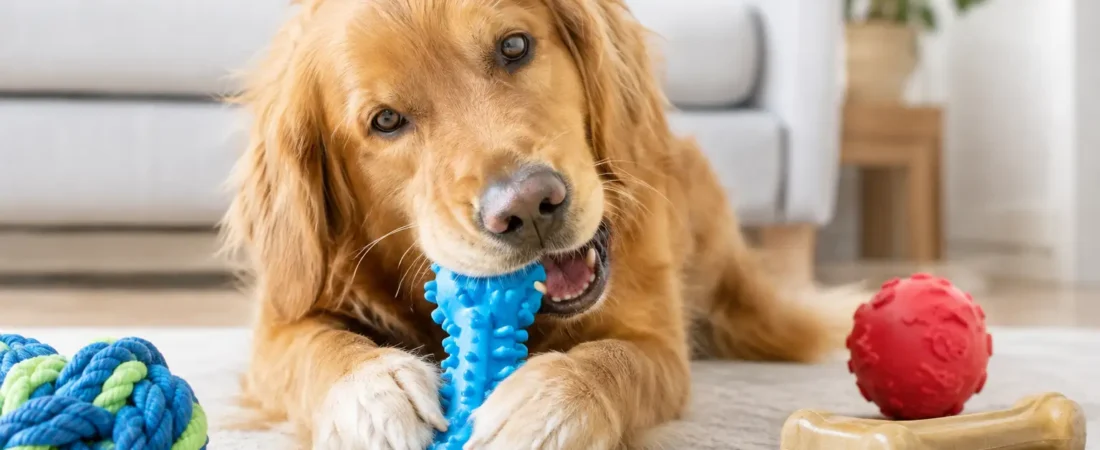
The chewed-up coffee table has submitted Exhibit A. The toy with one ear missing has submitted Exhibit B. Your dog, naturally, has declined to comment. Finding the best dog toys for chewers is less about buying the toughest-looking object on the shelf and more about matching a toy to the particular defendant in your living room.
A 10-pound terrier who works methodically on a toy for half an hour needs something different from a 75-pound mixed breed who treats every rubber ball like it owes him money. The right choice can direct normal chewing toward a safe outlet. The wrong one can become a choking hazard, a dental hazard, or a very brief expense.
Best Dog Toys for Chewers Start With the Chewer
“Chewer” is not one legal category. Before choosing a toy, consider how your dog does the job.
A gentle chewer mouths, carries, and occasionally gnaws. Plush toys, fleece tug toys, and softer rubber can work well, provided your dog does not pull out and swallow stuffing, squeakers, or fabric pieces.
A moderate chewer enjoys a daily gnaw but does not typically destroy a toy in minutes. These dogs often do well with durable rubber, thicker fabric toys with reinforced seams, and food-dispensing toys that make them work for a snack.
A power chewer is the household demolition specialist. Think of the Boxer who has already opened three shipping boxes without assistance, or the determined Dachshund who sees a seam as a personal challenge. These dogs generally need dense rubber, tough nylon, or purpose-built chew toys with no flimsy attachments.
There is also the shredder, who may not chew with enormous jaw pressure but loves pulling toys apart. For this dog, durability is not just about hardness. Avoid loose rope strands, thin plush, easy-to-grab fabric tags, and toys with small sewn-on features. A soft toy can be appropriate only under close supervision, and some shredders are better off with rubber enrichment toys instead.
Choose Materials With a Clear Safety Record
The material matters because every chew toy eventually meets teeth, saliva, and enthusiasm.
Rubber for flexible, satisfying chewing
Quality rubber toys are a strong first choice for many dogs. They have enough give to feel rewarding, yet can be durable enough to hold up to repeated chewing. Hollow rubber toys that can be stuffed with part of your dog’s regular meal are particularly useful for dogs who need something constructive to do when the house gets quiet.
Rubber is not automatically indestructible. Inspect it after use, especially if your dog can tear chunks from the edge. Once a toy has cracks, deep cuts, or missing pieces, its case is closed.
Nylon for determined gnawers
Nylon chew toys can suit dogs that prefer a firmer surface and steady chewing sessions. Many are shaped to encourage dogs to hold them with their paws, which can keep a busy dog occupied for a while.
The trade-off is hardness. A chew toy should not feel like a rock. Extremely hard items can damage teeth, particularly for committed gnawers. If you would worry about banging the toy against your kneecap, it may be too hard for unsupervised chewing. Watch for sharp edges or bristle-like fragments as the toy wears down.
Rope, fabric, and plush for supervised play
Rope toys can be enjoyable for tugging and interactive play, but they are not a universal chew solution. Dogs that swallow strands can face a serious intestinal problem, so retire rope toys when they fray heavily or unravel.
Plush toys are for dogs who can play gently and owners who can supervise. There is no shame in knowing your dog views plush toys as stuffed prey with a 90-second life expectancy. Choose another category and preserve your peace.
Edible chews need rules, too
Edible chews may satisfy a dog’s urge to chew, but they are not interchangeable with toys. Consider your dog’s size, chewing speed, food sensitivities, and tendency to gulp. Choose an appropriately sized option, supervise closely, and remove the final small piece before it becomes a swallowing contest.
Size and Shape Are Part of the Verdict
A toy should be large enough that your dog cannot swallow it whole, but manageable enough to carry and chew comfortably. Tiny toys for a large dog are obvious trouble. Oversized toys for a small dog may simply sit there, ignored like a subpoena on a Saturday.
Shape affects safety and interest, too. Round balls can be great for fetch, but select a size that cannot lodge at the back of your dog’s mouth. Long, handle-shaped rubber toys may be easier for dogs to grip. Food-stuffable toys offer mental work as well as chewing, which is valuable for dogs who become destructive when bored.
Skip toys with easily detached plastic eyes, bells, thin ribbons, or decorative parts. Also be cautious with anything that can splinter, including cooked bones, antlers, and sticks. Natural does not always mean low-risk. The backyard branch has no safety testing, no size guide, and an alarming record of splinters.
Match the Toy to the Moment
The best chew toy is not necessarily the same toy for every hour of the day. A durable rubber toy stuffed with kibble can help during a work call, while a tug toy is better for a short, supervised game together. A chew with a tempting texture may help settle a dog after a walk, when they are ready to decompress but not ready to nap.
Rotation also helps. Keep a few safe options and bring out two or three at a time rather than leaving every toy available forever. Familiar toys can feel new again after a few days away, and you can more easily notice when one has begun to break down.
For high-energy or highly intelligent dogs, chewing should be one part of the enrichment docket. A Border Collie may finish a chew and immediately begin reorganizing the household. Pair chew time with sniff walks, training games, food puzzles, and appropriate exercise. No toy can fairly be expected to replace a dog’s need for activity and connection.
Supervision Is Not the Boring Part
The first few sessions with a new toy are evidence-gathering sessions. Watch how your dog uses it. Do they gnaw steadily, rip at an edge, try to swallow it, or guard it intensely? Those details tell you more than a package label ever could.
Check toys regularly for cracks, loose pieces, worn seams, and changes in size. Replace damaged toys promptly. If your dog has broken a tooth before, has dental disease, gulps objects, or repeatedly eats nonfood items, ask your veterinarian for individualized guidance before introducing hard chews.
It is also wise to separate dogs when giving high-value chews. Even a normally friendly dog may object when a housemate wanders too close to the good stuff. Prevention is simpler than refereeing a dispute over a half-chewed treasure.
A Better Chew-Toy Routine
Start with one durable toy appropriate for your dog’s size and chewing style, then observe rather than assuming the label settled the matter. Offer it when you can supervise, remove it if it starts shedding pieces, and reserve special stuffed toys for moments when your dog needs a calm assignment.
Judge Fable’s court recognizes chewing as a normal canine behavior, not a character flaw. Give your dog a legal outlet, keep an eye on the evidence, and your furniture may finally receive the protection it has been begging for.